
From brain dump to DAG: turning a messy goal into a structured plan
The hardest moment in planning is not managing the plan. It is the blank page before there is one: a goal in your head, fuzzy at the edges ("launch the course by September", "get the funding round done"), and an empty canvas demanding structure you do not have yet. Most plans that never exist die right here, not because planning was too hard but because starting was.
This is the moment Topolog's Express mode is built for, and the interesting part is not "AI writes your plan". It is how: the same way a good consultant would, top-down, level by level, asking before assuming, with an inspector checking every step.
Level by level, not all at once#
The naive approach (prompt in, forty tasks out) produces what you would expect: a plausible wall of structure with hallucinated edges, an inconsistent middle, and no natural point for you to intervene. Express mode decomposes instead, breadth-first:
The goal becomes a handful of phases. First pass: three to seven top-level milestones with their dependencies and the plan's endings. Never more than seven, because the same working-memory bound that makes plans readable makes generation reliable (Miller's law, mechanically enforced). You see this skeleton render on the canvas almost immediately.
Ambiguity becomes questions, not assumptions. Where the goal is genuinely underdetermined (is there a budget? a hard deadline? is the course recorded or live?), the builder asks, at the level where the answer matters. Your answers are facts the rest of the decomposition conditions on. This is the step that separates "drafted for me" from "guessed at me".
Each phase opens into its pieces. Recursion: every milestone decomposes into its own two-to-seven children: tasks with estimated ranges, the outcomes they produce, the gates that branch on them. A panel reviews each level's cut before it sticks, and the structure grows on the canvas as it goes, left to right, level by level.
The engine seals it. The full deterministic gauntlet runs as the build finalises: the eighty-invariant validation, terminal-state synthesis, money model if a budget exists, calibration of priors (who checks whom, and why). What lands is not text that resembles a plan. It is a validated TOL program with a forecast already attached.
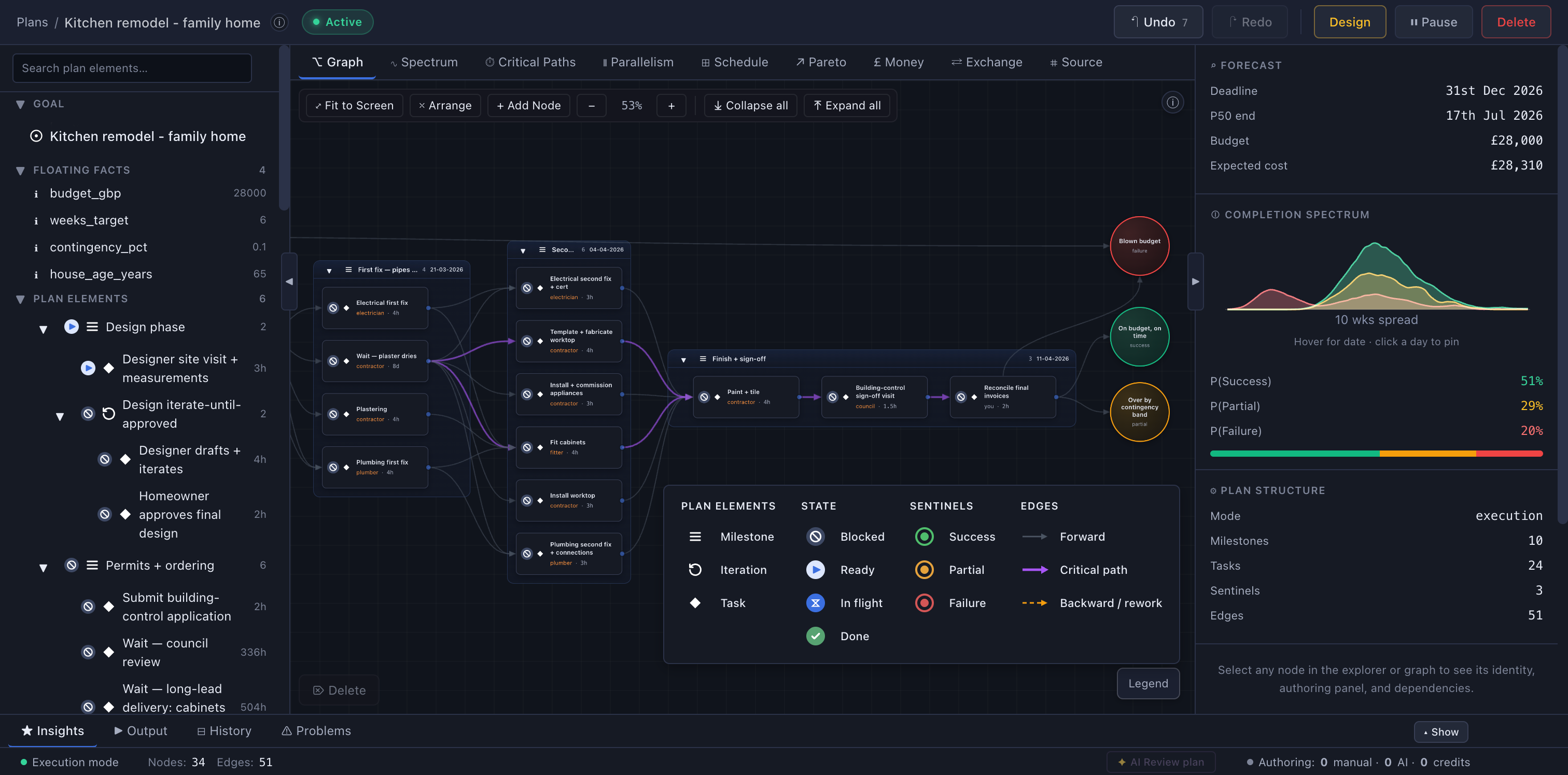
Minutes after the one-paragraph goal, you are looking at a dependency graph with a completion spectrum: the dates, the odds, the endings (how to read it).
The draft is a starting position, not a verdict#
A generated plan is a competent first take by a collaborator who has never met your project's specifics. Treat it accordingly, and notice that the review is structured rather than overwhelming, because the plan arrives in levels:
| Review pass | The question | Typical correction |
|---|---|---|
| Phases | Is this the actual shape of the work? | Merge two, add the one the model could not know about |
| Dependencies | What actually blocks what? | Usually additions: the cross-links only you know exist |
| Estimates | Are the centres and spreads yours? | Re-anchor a few; your ranges beat its defaults |
| Priors and endings | Are the odds and the failure modes honest? | The 0.7 on "approval passes" is a judgement: make it yours |
Every correction is an ordinary edit (canvas or source text), and the forecast recomputes as you go. Fifteen minutes of this and the plan has crossed the line that matters: from the model's plausible plan about a generic project to your committed plan about this one.
There is a stricter way to describe the whole flow, and it is the honest one: the blank page was never a structure problem, it was a translation problem. You already knew most of the plan; it was just stored as intuition, not as a graph. The decomposition loop is a translator with a good interviewing technique, and the validator is its proofreader. (If you would rather run the translation with your own model in a chat window, that workflow exists too, and it converges for the same reason: the proofreader does not care who wrote the draft.)
The blank canvas, it turns out, was the only unnecessary part of planning. The thinking was always necessary. It just goes better with a first draft to argue with.