
Pareto
Most plans have a knob: spend more and the odds improve, spend less and you keep cash but accept more risk. The Pareto tab makes that trade-off explicit. It sweeps the decisions in your plan - how much runway to commit, which scope or quality tier to pick - and plots the frontier: for every level of spend, the best probability of success you can buy.
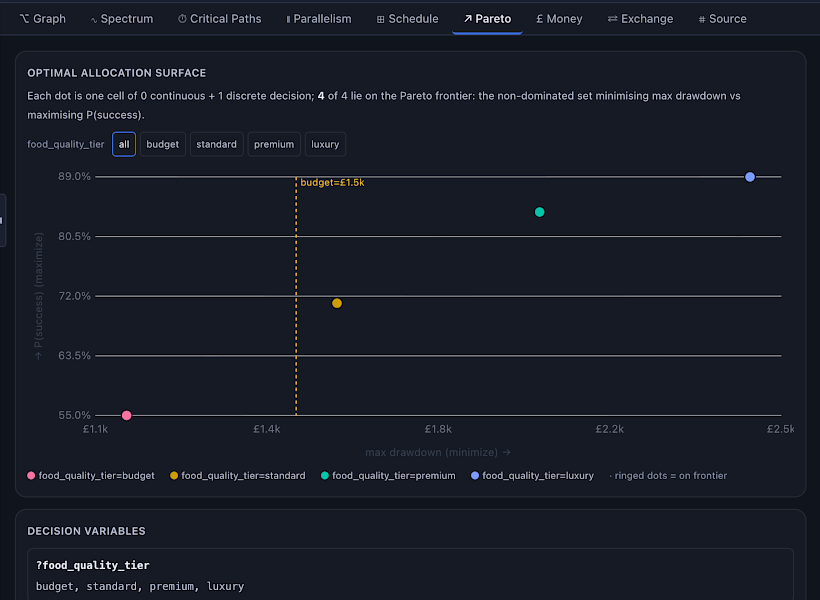
How allocation changes the outcome
The link from money to outcome is explicit, not hand-waved. When a plan is built with a budget, Topolog authors an allocation decision (for example a catering tier, or a build-vs-buy choice) and couples each option to the plan’s success outcome: the premium option lifts the probability of a successful finish, the lean option saves cash but lowers it. The forward pass applies that coupling, so changing the allocation genuinely moves the success odds rather than just the line on a spend chart.
Because every option is a real point in the decision space, the sweep can compare them head to head and keep only the ones worth keeping.
Reading the frontier
Each dot is one combination of decisions. A dot is on the frontier when nothing else does better on both axes at once - you cannot raise P(success) without spending more, and you cannot cut spend without giving up success. Dots below the frontier are dominated: some other allocation beats them on both counts, so there is never a reason to pick them.
The shape tells you where you are on the curve. A steep frontier means a little more money buys a lot more certainty - spend. A flat frontier means you are already past the point of diminishing returns - the extra spend barely moves the needle.
What to do with it
- Pick a point, not a number. Decide how much success you need, then read off the cheapest allocation that delivers it. Or fix your budget and read off the best odds it can buy.
- Find the knee. The bend in the frontier is the sweet spot: the last place where more money still pays for itself in success probability.
- Sanity-check the coupling. If a tier barely changes P(success), the plan is telling you the spend isn’t load-bearing - the risk lives somewhere money can’t fix.
When you can skip it
The Pareto tab needs a money model and at least one decision to vary. Plans with no budget and no scope choices have nothing to trade off, so the tab stays empty by design. Add a budget at build time to unlock it.